





Fall 2023 Hall of Fame
CONGRATULATIONS, Graduates!!
Here are the three Cs to keep in mind: Be Critical, Be Creative, and Be Compassionate.
Go out and make a difference in the world!
The faculty, graduate students, and staff are proud of you!
Bachelors of Art:
James Madden
Sophia Mostamand
Makanaokeakua Ramos
Blake Varner
Master of Art: Nikolas Janowicz with a thesis on “Demystifying Giulio Camillo’s L’Idea del Theatro: A Philosophical Interpretation”
Doctors of Philosophy:
Elijah Byrnes with a dissertation on “Living Death: Exhuming the Politics of Death and Remembrance in Arendt”
Benjamin Hoffman with a Dissertation on “The Concept of Ekstasis in the Modern Japanese Philosophy of Nishitani Keiji”
Also, congratulations to the following faculty!
Nominations for the Excellence in Teaching Award: Dr. Jonathan Fine (Assistant Professor) and Dr. Steve Odin (Full Professor)
“Discover Manoa Day”
(Art Auditorium, Saturday, October 21, 2023)

Diotima and Socrates. An Encounter for the Ages
Ella Marsh and Ruel Mannette, UH PhD Candidates in Philosophy
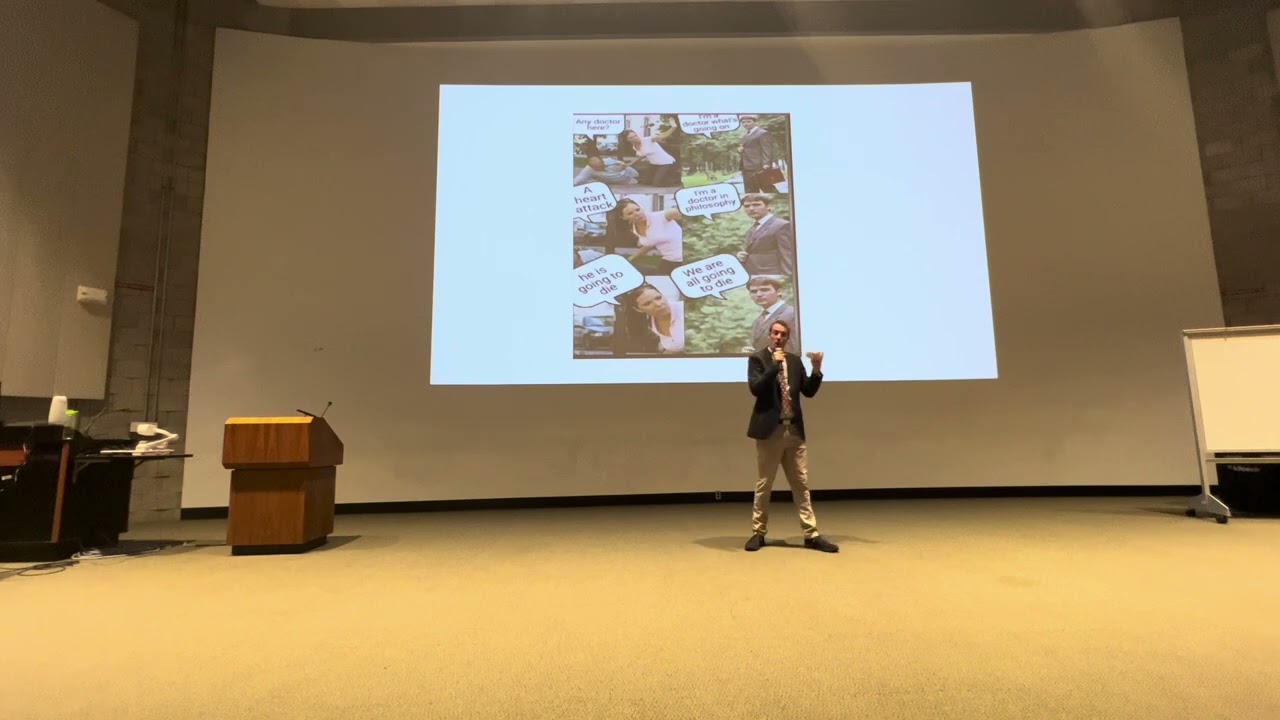
A Philosopher’s Self-Debate on the Subject of Death
Dr. Sean Smith, Assistant Professor, UH Department of Philosophy


Events
- How to Be a Nonconsequentialist and Still Save the Greater Number
 Thursday, May 2, 2024, 2:30 PM. Ben Kiesewetter is a Professor of Practical Philosophy at Bielefeld University in Germany. In this talk, Dr. Kiesewetter will criticize Scanlon’s contractualist attempt to defend the duty to save the greater number.
 - EAducation: Letters from Hawaiʻi to Palestine
 EAducation: Letters from Hawaiʻi to Palestine | Friday, April 26, 2024, 2:30 PM | Sakamaki Hall C-308
 - Equality & Elitism: Early Modern Women and the Philosophy of Friendship
 Thursday, April 25, 2024. Michaela Manson, PhD is an instructor at Simon Fraser University. In this talk, Dr. Manson will argue that accounts of friendship of some early modern women philosophers formulate the ideal of friendship in a way that averts the elitism objection while preserving commitments to virtue and similarity.
 - Knowing the Future: Based on Yijingʻs Theory of Situational Meaning
 Friday, April 19, 2024. The lecture will be followed by a reception celebrating Dr. Chung-ying Cheng’s retirement and over 60 years of service to the University of Hawaiʻi.
Click Here to View Past Events →