Discovery and Achievement on Many Fronts
From life-saving medical breakthroughs, to environmental protection, to economic stimulus, the scholarship and research conducted by the University of Hawai‘i impacts the quality of life on many levels.
UH research programs:
- develop human capital and new knowledge
- promote innovation and collaboration
- support new businesses and long-term job growth
- generate revenues that boost the local economy
- maximize the advantages of Hawai‘is unique natural and cultural heritage
Recent research news
Carbon Dioxide ModerationApril 28, Manoa — Researchers link pre-human carbon dioxide levels in the atmostphere with the breakdown of minerals in the Earth’s crust.
Engineering School CultureApril 28, Hilo — Emmeline G. de Pillis publishes on the pervasive culture of masculinity and hierarchy in some engineering schools.
Potential Anti-Cancer AgentApril 23, Manoa — An international team works out the structure and functional mechanism of a plant bacterium-produced molecule that may curb the growth of cancer cells.
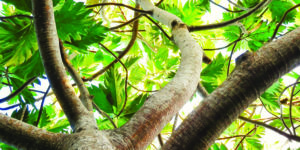
Cracking the Papaya CodeApril 23, Manoa — An International Papaya Genome Consortium deciphers the genetic code of the disease-resistant transgenic "SunUp" papaya.
Dynamical FrustrationApril 18, Hilo — Philippe Binder publishes on opposing trends in complex systems that address geometrical, computational and multiple-scale processes.Spotlight

Four Quark Meson
University of Hawaii at Manoa researchers working on the Belle experiment in Tsukuba, Japan discovered a new class of subatomic particle.
For the four decades that have elapsed since the birth of the quark idea, Murray Gell-Mann's three-quark baryon quark-antiquark meson description has sufficed to explain all observed particles. Recently, however, researchers led by Professor Stephen Olsen and Sookyung Choi have found a meson that that defies classification as a simple quark-antiquark state. This meson, called the Z(4430), is seen to decay into an electrically neutral psi’ meson—a well established charmed-quark anticharmed-quark state—plus a charged pi meson.